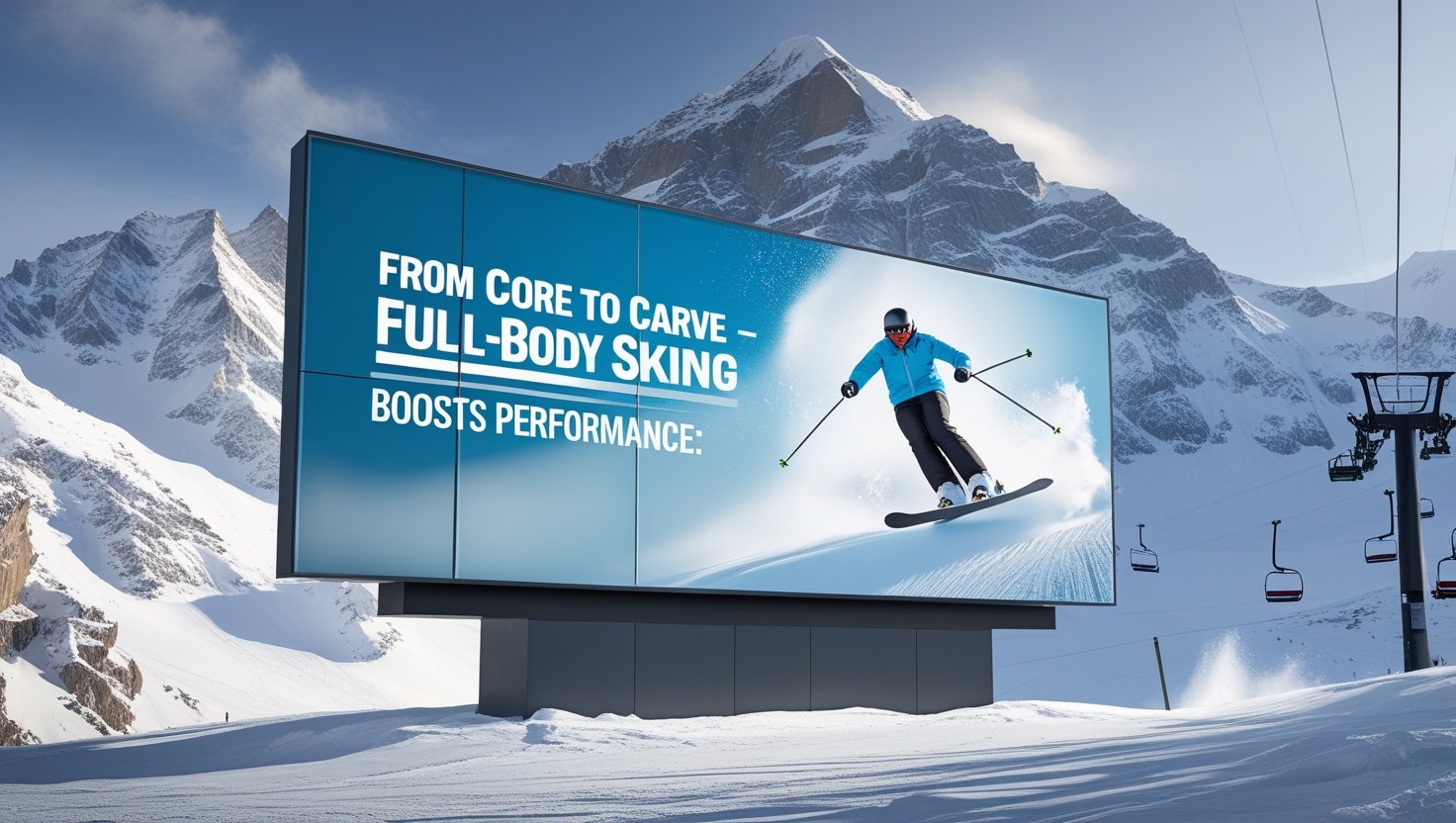
Ever wondered why some skiers glide down mountains like poetry in motion while others struggle with every turn? The secret isn’t just in their legs, it’s in understanding how full-body skiing performance transforms average skiers into mountain masters.
Why Your Core Determines Your Carve:
The relationship between core strength and skiing performance goes far deeper than most recreational skiers realize. Your core isn’t just your abs, it’s the powerhouse that connects your upper and lower body, creating the stability and control needed for precision carving.
Professional skiers understand that every perfect turn begins with core engagement. When your core muscles fire properly, they create a solid foundation that allows your legs to work efficiently while your upper body maintains perfect balance. This integrated approach transforms skiing from a leg-burning ordeal into a full-body symphony of controlled movement.
The science behind the core-to-carve connection reveals that stronger core stability directly correlates with improved edge control, better balance recovery, and reduced fatigue during long skiing sessions. This means more enjoyment on the slopes and fewer aches after your skiing adventures.
Beyond Traditional Leg-Only Approaches:
The Integrated Movement Philosophy:
Traditional ski training focuses heavily on quad strength and endurance, but this approach misses the bigger picture. Full-body skiing requires coordination between multiple muscle groups working in perfect harmony. Your shoulders initiate turns, your core provides stability, your legs control pressure, and your arms maintain balance.
This integrated approach means training should mirror skiing’s complex movement patterns rather than isolating individual muscle groups. Functional fitness for skiing emphasizes movements that translate directly to on-slope performance.
Core-Centric Training Principles:
Core stability for skiing extends beyond traditional crunches and planks. Effective core training for skiers includes:
- Rotational movements that mimic turning motions
- Anti-rotation exercises that build resistance to unwanted twisting
- Dynamic stability challenges that improve balance under pressure
- Power transfer movements that connect upper and lower body strength
The Anatomy of Superior Skiing Performance:
Upper Body Integration:
Your upper body skiing mechanics play a crucial role in overall performance. Strong shoulders and back muscles provide the foundation for proper pole planting and balance maintenance. When your upper body works correctly, it allows your lower body to focus on precise edge control and carving technique.
Shoulder stability becomes particularly important during challenging terrain or variable snow conditions. Weak shoulders force your legs to work harder for balance, leading to quicker fatigue and less controlled skiing.
Core Power Systems:
The core muscle groups essential for skiing include:
- Deep stabilizers (transverse abdominis, multifidus) for foundational stability
- Rotational muscles (obliques, quadratus lumborum) for turning power
- Anti-extension muscles (rectus abdominis) for maintaining proper posture
- Lateral stabilizers (quadratus lumborum, obliques) for edge control
Lower Body Coordination:
While legs remain crucial for skiing, lower body integration with core and upper body creates exponentially better results than isolated leg strength. The key lies in understanding how different muscle groups support each other during skiing movements.
Revolutionary Training Protocols for Peak Skiing Performance:
The Core-to-Carve Workout System:
This innovative training approach focuses on skiing-specific movements that build functional strength while improving coordination and balance.
Phase 1: Foundation Building (Weeks 1-4):
Stability-First Approach:
- Dead bugs – 3 sets of 10 each side
- Bird dogs – 3 sets of 12 each side
- Plank variations – Hold for 30-60 seconds
- Glute bridges – 3 sets of 15
Balance Integration:
- Single-leg stands – 30 seconds each leg
- Bosu ball exercises – Various positions
- Yoga tree pose – Hold 30 seconds on each side
- Stability ball movements – Core activation focus
Phase 2: Dynamic Movement (Weeks 5-8):
Rotational Power Development:
- Russian twists with medicine ball – 3 sets of 20
- Wood chops – 3 sets of 12 each direction
- Rotational lunges – 3 sets of 10 each leg
- Cable rotations – 3 sets of 15 each side
Multi-Planar Movements:
- Lateral lunges – 3 sets of 12 each leg
- Curtsy lunges – 3 sets of 10 each leg
- Lateral bounds – 3 sets of 8 each direction
- Multi-directional hops – 3 sets of 10 each direction
Phase 3: Sport-Specific Integration (Weeks 9-12):
Skiing Simulation Exercises:
- Ski jumps – 3 sets of 20
- Lateral skater hops – 3 sets of 15 each side
- Mogul simulation – 3 sets of 30 seconds
- Carving stance holds – 3 sets of 45 seconds
Advanced Performance Protocols:
Explosive Movement Training:
- Jump squats – 4 sets of 8
- Plyometric lunges – 4 sets of 6 each leg
- Box jumps – 4 sets of 5
- Lateral bounds – 4 sets of 6 each direction
Endurance-Strength Combinations:
Metabolic Conditioning:
- Ski-specific circuit training – 5 rounds, 45 seconds work/15 seconds rest
- Interval training – High-intensity bursts with active recovery
- Compound movement sequences – Combining multiple exercises
- Time-under-tension protocols – Slow, controlled movements
Mental-Physical Integration:
Visualization and Movement Patterns:
Mental training for skiing involves visualizing perfect turns while performing exercises. This neuromuscular approach strengthens the mind-body connection essential for advanced skiing techniques.
Proprioceptive training improves your body’s awareness of position and movement in space. This enhanced awareness translates directly to better balance and control on the slopes.
Reaction Time and Adaptability:
Skiing performance often depends on split-second adjustments to changing conditions. Training that incorporates unpredictable elements improves reaction time and adaptability.
Cognitive load training involves performing exercises while processing information or making decisions, mimicking the mental demands of skiing challenging terrain.
Nutrition and Recovery for Optimal Skiing Performance:
Fueling Full-Body Performance:
Skiing nutrition must support both endurance and power demands. The sport requires sustained energy for long days on the mountain, plus explosive power for challenging terrain.
Key nutritional strategies:
- Complex carbohydrates for sustained energy
- Lean proteins for muscle recovery and strength
- Healthy fats for hormone production and inflammation control
- Hydration protocols for altitude and cold weather performance
Recovery Protocols:
Active recovery between training sessions prevents overuse injuries while maintaining fitness gains. This includes light cardiovascular exercise, stretching, and mobility work.
Sleep optimization becomes crucial for skiing performance. Quality sleep enhances reaction time, decision-making, and physical recovery.
How Gear Supports Full-Body Performance:
Boot Fitting and Biomechanics:
Proper ski boot fitting directly impacts full-body performance. Poorly fitted boots force compensatory movements that reduce efficiency and increase injury risk.
Biomechanical alignment through proper boot setup allows optimal power transfer from your core through your legs to your skis.
Ski Selection for Performance:
Ski characteristics should match your full-body skiing style and ability level. Skis that are too challenging or too easy prevent optimal performance development.
Progressive equipment choices allow skills to develop naturally while supporting improved performance.
Injury Prevention Through Comprehensive Training:
Common Skiing Injuries and Prevention:
Skiing injury prevention requires understanding the most common injury patterns and training specifically to prevent them.
High-risk areas:
- Knee injuries – Prevented through proper strength and flexibility training
- Shoulder injuries – Reduced through upper body conditioning
- Back injuries – Minimized with core strengthening
- Wrist injuries – Prevented through proper technique and conditioning
Prehabilitation Strategies:
Preventive exercises performed consistently reduce injury risk while improving performance. These exercises target common weakness patterns in recreational skiers.
Movement screening identifies potential problem areas before they become injuries, allowing targeted intervention.
Seasonal Periodization for Year-Round Performance:
Off-Season Foundation Building:
Summer training for skiing focuses on building the aerobic base and movement patterns that support winter performance.
Cross-training activities like mountain biking, hiking, and swimming maintain fitness while providing variety.
Pre-Season Intensification:
Pre-season ski training increases intensity and sport-specific movements as winter approaches.
Skill rehearsal through dry-land exercises helps maintain movement patterns between seasons.
In-Season Maintenance:
Maintenance training during ski season preserves fitness gains while avoiding overtraining.
Performance optimization focuses on fine-tuning rather than building new fitness.
From Intermediate to Expert:
Carving Mastery Through Full-Body Integration:
Advanced carving techniques require perfect coordination between all body systems. The core initiates movement, the legs control pressure, and the upper body maintains balance.
Edge control mastery comes from understanding how subtle core adjustments influence ski performance.
Terrain Adaptation Strategies:
Variable terrain skiing demands rapid adaptation and full-body coordination. Training should prepare skiers for diverse conditions and challenges.
Mogul skiing particularly benefits from full-body training approaches, as it requires rapid adjustments and sustained power output.
Technology and Performance Tracking:
Wearable Technology for Skiing:
Performance monitoring through wearable devices provides objective feedback on skiing improvement.
Data-driven training allows precise adjustments to training programs based on actual performance metrics.
Video Analysis and Technique Refinement:
Skiing technique analysis through video review identifies areas for improvement and tracks progress over time.
Movement pattern analysis reveals how full-body training translates to on-slope performance.
Building Your Personal Performance Program:
Assessment and Goal Setting:
Skiing performance assessment should include strength, flexibility, balance, and endurance testing.
SMART goal setting for skiing creates clear targets and timelines for improvement.
Progressive Program Design:
Individualized training programs account for current fitness level, skiing experience, and personal goals.
Periodization planning ensures consistent progress while preventing plateaus and overtraining.
Conclusion:
The transformation from average to exceptional skiing performance lies in understanding and implementing full-body skiing principles. Your core provides the foundation, but true skiing mastery comes from integrating all body systems into coordinated, powerful movement patterns. Start implementing these full-body training principles today, and watch your skiing performance reach new heights. Remember, every expert skier started as a beginner who refused to accept limitations and embraced comprehensive training approaches.
FAQs:
1. How does core strength specifically improve skiing performance?
Core strength provides stability for precise edge control and reduces leg fatigue during long skiing sessions.
2. What’s the most important full-body exercise for skiing improvement?
Rotational exercises like wood chops mimic turning movements while building core-to-extremity power transfer.
3. How long does it take to see skiing performance improvements from full-body training?
Most skiers notice improved balance and control within 4-6 weeks of consistent full-body training.
4. Should I focus more on strength or flexibility for skiing performance?
Both are essential – strength for power and control, flexibility for injury prevention, and fluid movement.
5. Can full-body training replace traditional leg-focused ski workouts?
Full-body training is more effective than leg-only workouts because skiing requires total body coordination.
6. What’s the biggest mistake recreational skiers make in their training?
Focusing only on leg strength while neglecting core stability and upper body integration is essential for advanced skiing.
Leave a Reply